The Two-Block Walk That Built a Generation: How America Stopped Letting Kids Get Themselves to School
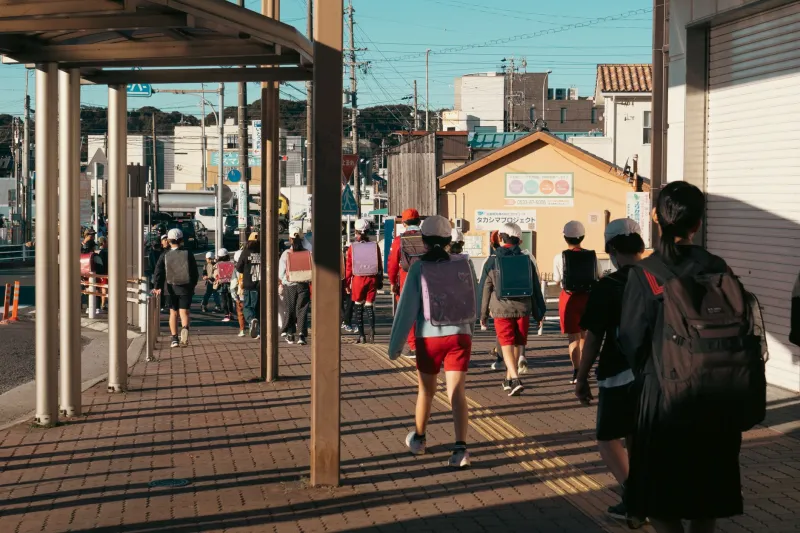
Somewhere in an old photo album, there's probably a picture of your parent or grandparent standing on a sidewalk with a lunchbox, alone, grinning. No adult in frame. No minivan idling at the curb. Just a kid, a block, and a destination. That image feels almost quaint now — maybe even a little alarming — and that reaction alone tells you something important about how dramatically the American childhood has shifted.
For most of the twentieth century, walking to school wasn't a parenting philosophy. It was just what kids did.
The Neighborhood School Era
The logic was baked into the infrastructure. American cities and towns were designed around neighborhood schools — elementary buildings within walking distance of most of the homes they served. In the postwar suburbs, developers and school boards worked in rough alignment, placing schools at the center of residential clusters. A child's walk might be six blocks, might be half a mile, might wind through a couple of familiar streets past neighbors who knew their names.
That familiarity was the whole point. Kids didn't just get to school — they learned the geography of their own community. They figured out which shortcuts worked, which dogs barked, which neighbors left their sprinklers on too long. Older kids looked out for younger ones without being asked. A scraped knee two blocks from home meant knocking on Mrs. Patterson's door, not calling a parent on a cell phone.
Nobody called it "building independence." It was just Tuesday.
By the 1970s, roughly half of all American children walked or biked to school. The number today? Somewhere around 10 to 13 percent, depending on the study. That collapse didn't happen overnight, and it didn't happen for one reason.
The Sprawl Problem
The first culprit is geography. As American suburbs spread outward through the 1980s and 1990s, the relationship between homes and schools broke down. New subdivisions were built far from existing school buildings. Arterial roads got wider and faster. Cul-de-sacs replaced grid streets, creating neighborhoods that were technically close to a school but practically impossible to reach on foot without crossing a six-lane highway.
School consolidation made things worse. Smaller neighborhood schools were closed in favor of larger regional campuses that served more students more efficiently — and were accessible to almost none of them on foot. A child who might have walked four blocks to a neighborhood elementary in 1965 was now being bused twenty minutes to a campus on the edge of town.
The bus became the default. The carpool became the backup. The walk became the exception.
The Fear Factor
But distance alone doesn't explain everything. Even in walkable neighborhoods — the kind that exist in older cities and inner-ring suburbs — the rate of kids walking to school has fallen sharply. And that decline tracks closely with something harder to measure: fear.
The 1980s were a turning point in how Americans perceived danger to children. High-profile abduction cases, amplified by a new 24-hour news cycle, created a national anxiety about stranger danger that was intense, widespread, and largely disconnected from statistical reality. The actual rate of stranger abductions in the US has remained extremely low and has not meaningfully increased since the era when kids walked freely. But perception shifted hard, and it never fully shifted back.
Parents who had walked to school themselves began driving their own children. Not because the streets were more dangerous — they largely weren't — but because the cultural tolerance for unsupervised childhood movement had evaporated. What was once considered normal became, in the eyes of many, reckless.
By the 2000s, parents in some states faced legal scrutiny for allowing kids to walk home alone. The term "free-range parenting" emerged — not as a description of something radical, but as a label for doing what every previous generation had done without naming it.
What Got Lost in the Carpool Lane
It's easy to frame this as a safety story, but it's really a story about what children learn when they navigate the world on their own terms. The walk to school was never just transportation. It was daily practice in self-reliance. Kids made decisions — when to cross, which route to take, how to handle the kid who wanted to take their lunch money. They experienced boredom, weather, and minor adversity without adult mediation.
Researchers who study childhood development have spent years documenting what happens when those experiences disappear. Kids who move through the world with constant adult supervision tend to develop differently — not worse in every way, but with measurable gaps in risk assessment, problem-solving, and the kind of low-grade confidence that comes from knowing you can handle a two-block walk by yourself.
There's also a community dimension. The walk to school was one of the few moments when kids from different households mixed organically, without organized playdates or structured activities. It was informal, unpredictable, and socially generative in ways that a carpool ride simply isn't.
Are Things Shifting Again?
There are signs of a slow reversal. Several states have passed "reasonable childhood independence" laws that explicitly protect parents who allow kids to walk or play outside unsupervised. Safe Routes to School programs have invested in better crosswalks, bike lanes, and pedestrian infrastructure in dozens of cities. Urbanist-minded school districts have started reconsidering consolidation.
And among parents who grew up in the walkable era, there's a growing nostalgia — not just for the walks themselves, but for what they represented. The idea that a neighborhood could be a place where a child moved freely, known and watched over by the community itself rather than by any single adult.
That's not a return to some mythologized past. It's a recognition that something genuinely useful was lost when America stopped letting its kids get themselves to school. The two-block walk wasn't just exercise. It was, quietly, an education.