The Human Being Who Could Move a Grocery Line Faster Than Any Machine
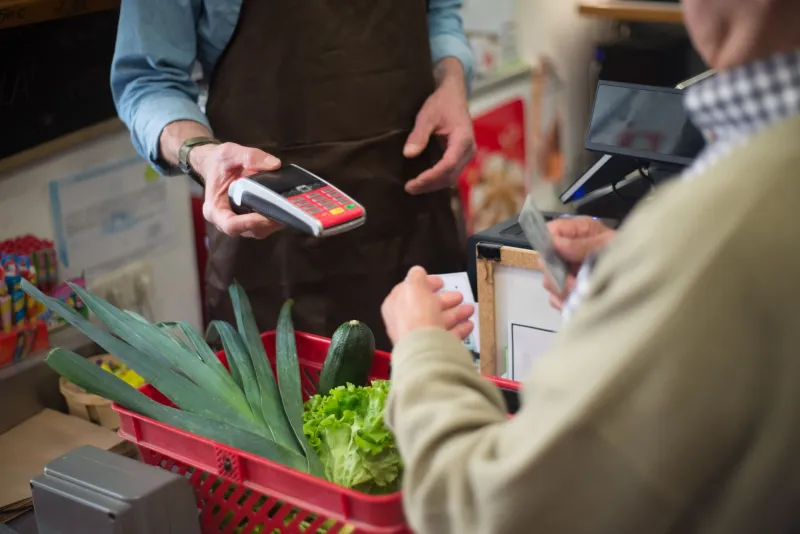
If you've stood at a self-checkout kiosk lately — waiting for the screen to stop telling you to remove the item from the bagging area, or hunting through a photo grid trying to identify the difference between a shallot and a pearl onion — you may have had a fleeting thought about the person who used to do this job. Not a frustrated thought, necessarily. More like a puzzled one. How did they do it so fast?
The answer is that being a skilled supermarket cashier was, for a few decades in American retail history, a genuinely demanding and underappreciated craft. And the story of how that craft was invented, refined, and then systematically replaced says something interesting about what Americans actually want from the places they shop — and what they quietly gave up when they accepted the trade.
The Science Behind the Speed
The modern supermarket as Americans know it — wide aisles, fluorescent lights, the long conveyor belt at checkout — was essentially a postwar invention. Stores like Kroger, Safeway, and A&P expanded dramatically through the 1950s and 1960s, and with that expansion came the need for checkout operations that could handle serious volume.
In the early decades, cashiers worked from memory and intuition. Barcodes didn't arrive in American grocery stores until 1974, when a pack of Wrigley's chewing gum became the first product in history scanned at a register in a Marsh Supermarket in Troy, Ohio. Before that, cashiers keyed in every price manually. They memorized which items were on sale that week. They knew the store's inventory the way a mechanic knows an engine.
 Photo: Marsh Supermarket in Troy, Ohio, via assets-global.website-files.com
Even after barcodes arrived, a significant portion of the job remained manual. Produce — fruits, vegetables, bulk items — doesn't come with a barcode. It comes with a four-digit PLU code that the cashier had to know by heart. A busy store might carry 300 produce items. A good cashier could recall most of them without looking. Russet potato: 4072. Banana: 4011. Broccoli crown: 3082. Not because anyone required them to memorize it, but because speed was the job, and looking things up was slow.
Reading the Belt Like a Chess Board
The conveyor belt was where the real expertise showed. A skilled cashier didn't just scan items in the order they arrived. She managed the flow — grouping items mentally by category, anticipating the bagging sequence, keeping heavy things separate from bread and eggs before the customer even had a chance to request it. She could glance at a loaded belt and see, in a single sweep, how the whole transaction was going to move.
Regular customers noticed. There was a reason people had favorite checkout lanes, and it wasn't always about the shortest line. Some cashiers were simply faster, smoother, more pleasant — and their lines moved better even when they were longer. The social dimension mattered too. A good cashier remembered that the woman with the organic milk always had a coupon that needed to be scanned last. She knew the older gentleman on Tuesday mornings liked to pay with exact change and needed a moment to count it out.
This was customer service in the most literal sense — service calibrated to specific customers, delivered consistently, without a script.
The Professionalization That Nobody Celebrated
At the height of American grocery retail — roughly the 1970s through the mid-1990s — cashier positions at major chains were often unionized, reasonably well-compensated, and treated as skilled labor. The United Food and Commercial Workers union represented hundreds of thousands of grocery employees and negotiated wages and benefits that made these jobs genuinely sustainable for working-class Americans.
Training programs were real. New cashiers at major chains went through structured onboarding that covered not just register operation but store layout, produce identification, loss prevention, and customer interaction. The job had a career arc — you could move from cashier to head cashier to department supervisor to assistant manager. Grocery retail was, for a significant number of Americans, a legitimate profession rather than a temporary gig.
None of that was celebrated in the culture. Cashiers were largely invisible in the national conversation about work and skill and labor. But they were doing something genuinely difficult, at volume, every day.
The Machine That Was Supposed to Help
Self-checkout arrived in American stores in the early 1990s, with Kroger and other chains experimenting with early kiosk systems. The pitch to consumers was intuitive: skip the line, scan your own items, get out faster. The pitch to retailers was even more straightforward: replace paid labor with machines that don't require benefits.
The reality has been messier than either pitch suggested. Self-checkout kiosks have consistently higher error rates than human cashiers — both honest mistakes by confused customers and deliberate theft, which retailers euphemistically call "shrinkage." Studies have found that self-checkout lanes generate significantly more inventory loss than staffed lanes, a problem that has become serious enough that some major chains, including Walmart and Dollar General, have begun pulling back on self-checkout in certain stores.
The speed advantage, meanwhile, is more conditional than advertised. Self-checkout is faster for a customer with eight items and no produce. It is slower — often dramatically slower — for a customer with a full cart, any age-restricted items, anything that needs to be weighed, or any product whose barcode is damaged. The machine that was supposed to make everything faster has, in practice, made a significant percentage of grocery transactions longer and more frustrating.
What the Transaction Lost
There's a subtler cost that doesn't show up in efficiency metrics. The checkout lane was, for a long time, one of the few remaining points of genuine human contact in the grocery shopping experience. It was brief and transactional, sure — but it was real. Someone looked at you. Someone said good morning. Someone noticed if you seemed tired or rushed or if you were buying ingredients for something interesting.
For elderly shoppers, for people who live alone, for anyone whose social world has contracted — that two-minute exchange at the checkout lane wasn't nothing. It was a small but consistent reminder that you were part of a community of people moving through the same routines.
The self-checkout kiosk offers no such reminder. It offers a screen, a scale, and an automated voice that has been telling you to please wait for an attendant for the past thirty years.
The Shift That Keeps Shifting
American retail is still figuring out where self-checkout belongs. Some stores are experimenting with hybrid models. Others are quietly rehiring cashiers after years of kiosk expansion. Amazon's cashierless Go stores, once heralded as the future of grocery shopping, have been scaled back significantly after proving more expensive to operate than anyone expected.
What's becoming clear is that the cashier wasn't just a cost to be eliminated. She was a skill set, a social function, and a quality-control mechanism that the machines haven't fully replaced. The checkout lane got automated. Whether it actually got better is a question that a lot of grocery chains are still trying to answer.