Everybody's on the Line: The Era When Your Phone Call Was the Whole Neighborhood's Entertainment
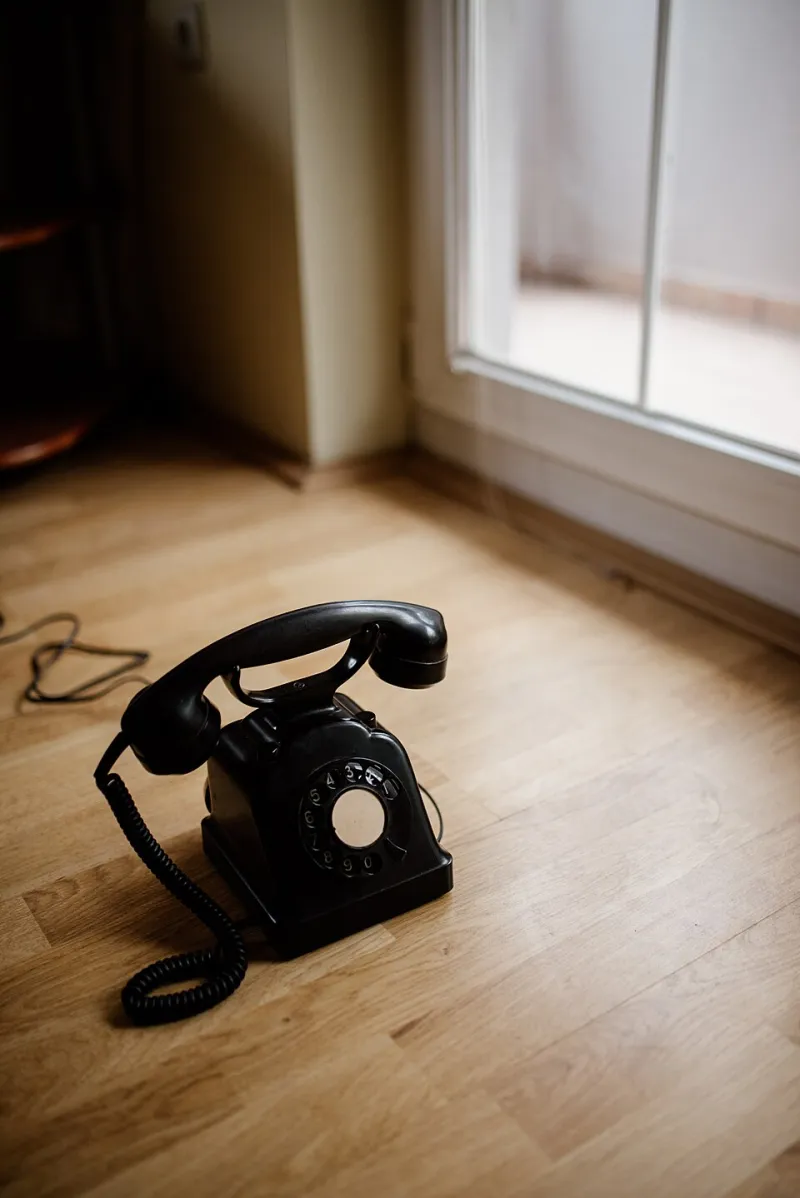
Photo: Shixart1985, CC BY 2.0, via Wikimedia Commons
Everybody's on the Line: The Era When Your Phone Call Was the Whole Neighborhood's Entertainment
Picture this: you pick up the phone to call your doctor, and before you even dial, you hear two of your neighbors deep in conversation about the Hendersons' new car. You wait. Maybe you clear your throat. One of them sighs, says "someone's waiting," and they wrap it up. You get your call. And somewhere down the road, someone else picks up their receiver and listens to every word.
 Photo: Hendersons, via i2-prod.edinburghlive.co.uk
This wasn't a privacy nightmare. This was Tuesday in rural and small-town America for a good chunk of the twentieth century. It was called the party line, and for millions of households, it was simply how the telephone worked.
How the Party Line Actually Functioned
The mechanics were straightforward, even if the social dynamics were anything but. A party line connected multiple households — sometimes four, sometimes eight, sometimes more — to a single shared telephone circuit. Each home had a distinct ring pattern. Two short rings might mean the call was for the Millers. One long and one short meant the Garcias. You learned to recognize your ring the way you learned to recognize your own name.
The system wasn't a quirk or a stopgap. It was the intentional design of early telephone infrastructure, particularly in rural areas where the cost of running individual lines to every farmhouse would have been prohibitive. The Bell System and its rural cooperatives built out coverage using shared lines because it was the only financially viable way to get phones into the hands of ordinary Americans. By the late 1940s, the majority of telephone subscribers in rural parts of the country were on party lines. Even in some suburban areas, shared lines persisted well into the 1950s and 60s.
 Photo: Bell System, via c8.alamy.com
Private lines existed, but they cost more. A lot more, in relative terms. If you wanted genuine telephone privacy in 1952, you paid for it.
The Unwritten Rules of Shared Conversation
What's remarkable, looking back, is how thoroughly Americans adapted to a system that offered essentially zero communication privacy. Communities developed elaborate informal codes of conduct around the party line — norms that were never written down but were understood by everyone who used one.
You didn't eavesdrop. Or rather, you weren't supposed to, and everyone knew you did anyway. There was a difference between passively hearing the first few seconds of a neighbor's call before hanging up and actively pressing the receiver to your ear for twenty minutes. The former was acknowledged and forgiven. The latter was a social transgression — the kind that followed you to church on Sunday.
You kept calls short. Monopolizing a shared line was considered rude in the same way that hogging the only bathroom in a boarding house was rude. If someone had an emergency — a sick child, a farm crisis, a family situation — they could ask other households to clear the line, and the expectation was that they would.
And you were careful what you said. Not careful in a legal sense, but careful in the way that people are careful when they know their words will travel. Sensitive topics got handled in person. Arguments stayed inside the house. The party line had a way of enforcing a certain baseline of public discretion simply by existing.
The Information Network Nobody Officially Acknowledged
Here's the thing nobody quite admits in the sanitized historical accounts: the party line was also a genuinely effective community information system. News traveled fast on a shared circuit. If the Hendersons' barn caught fire, half the neighborhood knew before the fire truck arrived. If a family was struggling, the informal intelligence network of the party line meant that casseroles showed up without anyone having to ask.
There was a social texture to shared communication that is almost impossible to replicate today. You knew the rhythms of your neighbors' lives — when they made calls, who they talked to, what kinds of things preoccupied them — without ever intending to. That ambient awareness created a kind of accidental community. Not always comfortable, not always welcome, but undeniably connective.
Gossip flourished, obviously. The party line was paradise for anyone who liked to know other people's business, and plenty of people did. But gossip, for all its problems, is also a form of social bonding — a way communities process information about their members, enforce norms, and maintain awareness of who needs help and who's causing trouble. The party line was a gossip superhighway, and its disappearance took that function with it.
From Shared Circuits to Encrypted Everything
Private residential lines became the standard through the 1960s and 70s, and by the 1980s, the party line was largely a memory. The transition wasn't just technological — it reflected a deepening American conviction that communication was private by right, not by luck.
That conviction has only intensified. Today's communication landscape is defined by end-to-end encryption, disappearing messages, private DMs, and a general expectation that what you say to one person stays with that person. The idea of a neighbor casually overhearing your phone call feels not just outdated but genuinely violating — a category of intrusion that would prompt outrage in a way it simply didn't in 1955.
We have gained something real in that shift. Privacy matters. The ability to communicate without surveillance — even neighborly, well-intentioned surveillance — is a meaningful freedom. People with stigmatized identities, difficult medical situations, or simply complex private lives are better served by a world where their conversations belong to them.
But something dissolved too. The party line, for all its invasiveness, was a system that made people aware of each other in an ongoing, low-level way. It was friction — the kind of friction that forces acknowledgment. You couldn't pretend your neighbors didn't exist when you might pick up the phone and hear their voices.
Today we have more privacy and less connection than perhaps any previous generation of Americans. We communicate constantly and, in many ways, more intimately than ever — but almost entirely within self-selected circles, with people we've already chosen. The accidental community of the party line, the neighbor you didn't choose but couldn't ignore, is gone.
Somewhere between everyone's business and nobody's business, we lost something worth noticing.