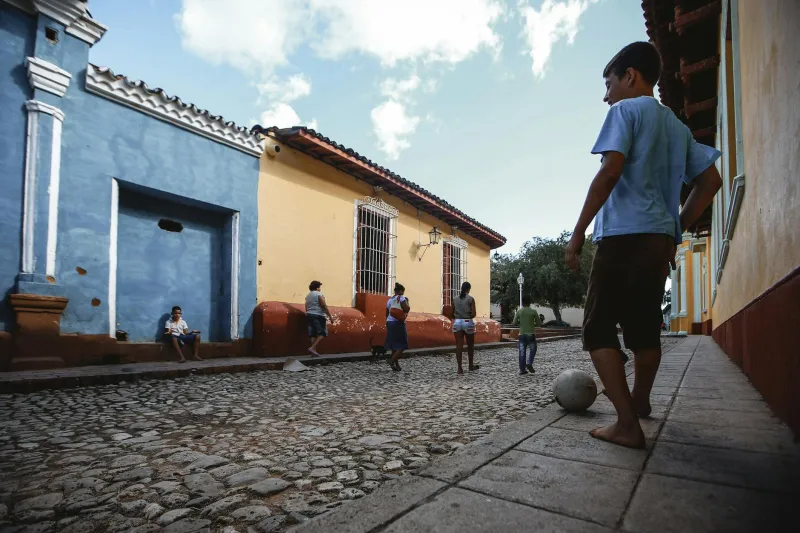
Picture this: it's 3:30 PM on a Tuesday in 1975. School buses rumble through suburban neighborhoods, dropping off kids who immediately dump their backpacks by the front door and disappear until dinnertime. No adult supervision required. No scheduled activities. No screens to retreat to.
These children built elaborate fort systems in nearby woods, organized pickup baseball games in empty lots, and invented complex imaginary worlds that could last for weeks. They explored storm drains, climbed trees that would horrify today's parents, and learned to navigate social conflicts without adult mediation.
Fast-forward to today: that same 3:30 PM finds most American children indoors, transitioning from structured school time to equally structured afternoon activities, homework supervision, or screen time. The transformation is so complete that we barely remember what we've lost.
The Numbers Behind the Shift
The statistics are staggering. According to the National Wildlife Federation, children today spend half as much time outdoors as their parents did. The average American child now spends just 4-7 minutes per day in unstructured outdoor play, compared to 7+ hours daily on screens.
In 1971, 85% of children walked or biked to school. Today, fewer than 13% do. The "radius of activity" — how far from home children are allowed to roam unsupervised — has shrunk by 90% since the 1970s. A distance that would have been a casual afternoon adventure for previous generations now represents the outer limits of acceptable childhood independence.
When the Neighborhood Was the Playground
For most of American history, children's after-school time belonged to them. Kids formed loose confederations that spanned multiple blocks, creating their own entertainment from whatever materials they could scrounge up.
"We had this elaborate system of forts connected by tunnels we'd dug in the vacant lot behind the Sears," remembers Janet Morrison, who grew up in suburban Detroit in the 1960s. "Parents had no idea where we were half the time, and that was completely normal. The rule was just be home when the streetlights came on."
These unsupervised hours weren't just fun — they were educational in ways we're only beginning to understand. Children learned to assess physical risks, negotiate complex social dynamics, and develop what psychologists call "executive function" — the ability to plan, organize, and solve problems independently.
The Perfect Storm of Indoor Migration
What drove American children indoors? The shift wasn't sudden but rather the result of several converging forces that gained momentum through the 1980s and 1990s.
First came the "stranger danger" panic. High-profile kidnapping cases, amplified by 24-hour news coverage, convinced parents that the world had become fundamentally more dangerous for children. In reality, stranger abductions remained extremely rare, but perception became reality.
Simultaneously, American neighborhoods were becoming less child-friendly. Suburban sprawl created car-dependent communities where walking anywhere required navigating busy roads. The corner stores, vacant lots, and walkable destinations that had anchored children's independent exploration disappeared.
The Rise of Scheduled Childhood
As outdoor play diminished, organized activities rushed to fill the void. Soccer leagues, piano lessons, tutoring sessions, and summer camps became the new normal. Parents, often working longer hours themselves, found comfort in knowing exactly where their children were and what they were doing every moment after school.
"I drive my kids to three different activities every week," explains suburban mom Lisa Chen. "When I was their age, I just... played. But that doesn't feel safe anymore, and besides, all the other kids are in programs too. There's nobody left in the neighborhood to play with."
This scheduling arms race created a self-reinforcing cycle. As fewer children played outside, neighborhoods emptied of the critical mass needed for spontaneous play. The remaining outdoor kids had nobody to play with, driving them indoors or into organized activities.
The Screen Solution
Then came the ultimate indoor attraction: screens. Video games, cable television, and eventually smartphones and tablets offered children engaging alternatives to outdoor play. Unlike the boring safety of staying inside in previous eras, screens provided instant entertainment that could compete with — and often surpass — the appeal of outdoor adventures.
Today's children inhabit richly detailed digital worlds that previous generations could only imagine. They collaborate with friends in online games, create elaborate content for social media, and access virtually unlimited entertainment. But they're doing it all from their bedrooms.
What We Gained and Lost
The indoor migration wasn't entirely negative. Today's children are safer from traffic accidents, serious injuries, and the rare but real dangers that outdoor play can present. They're more supervised, more scheduled, and arguably more prepared for academic success.
But the costs are becoming clear. Childhood obesity rates have tripled since the 1970s. Anxiety and depression among children have skyrocketed. Teachers report that kids struggle more with conflict resolution, creative problem-solving, and independent decision-making — skills that unstructured outdoor play naturally developed.
"These kids can navigate complex video games but panic when asked to organize a simple group activity," observes elementary school teacher Marcus Rodriguez. "They're incredibly sophisticated in some ways but surprisingly helpless in others."
The Resilience Factor
Perhaps most importantly, unstructured outdoor play built resilience in ways we're only beginning to appreciate. Children learned to cope with boredom, handle minor injuries, navigate social rejection, and bounce back from failures — all without adult intervention.
"We got hurt, we figured out how to fix it," recalls Tom Bradley, who spent his 1970s childhood roaming the hills outside Phoenix. "We got in fights, we worked it out. We got scared, we dealt with it. Those experiences taught us that we could handle things."
Signs of Change
Some communities are recognizing what's been lost and working to bring children back outdoors. "Adventure playgrounds" with loose parts and calculated risks are appearing in progressive neighborhoods. Schools are extending recess and reducing homework loads. Some parents are consciously stepping back from the supervision and scheduling that defined their own parenting.
But the broader cultural shift remains intact. American childhood has moved indoors, and an entire generation is growing up with fundamentally different relationships to risk, independence, and unstructured time.
The question isn't whether we can turn back the clock — we can't. But we might ask whether the trade-offs we've made are worth what we've given up, and whether there are ways to give children back some of what they've lost without sacrificing what they've gained.