Thirty-Six Chances: What Film Photography Taught America About Paying Attention
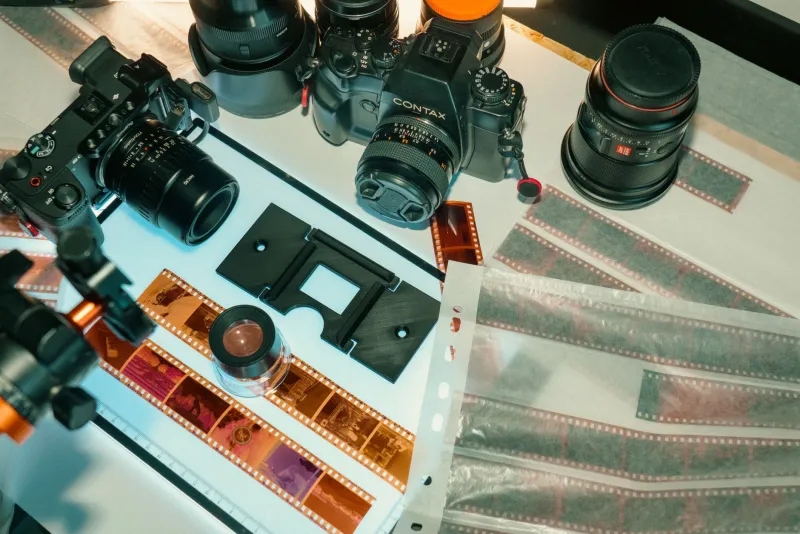
Somewhere in a closet, tucked behind the holiday decorations and the box of cables nobody can identify, there's probably a shoebox. Inside it: a stack of printed photographs, edges slightly yellowed, some blurry, some overexposed, all of them somehow more vivid in memory than anything sitting in your phone's camera roll right now.
That's not nostalgia talking. That's something real — and understanding why it feels that way says a lot about how dramatically photography has shifted, and what we quietly gave up when it did.
The Economy of the Shutter
For most of the twentieth century, taking a photograph was a considered act. A standard roll of 35mm film gave you 24 or 36 exposures. That was it. Once the roll was finished, you drove it to a drugstore or mailed it to a processing lab, paid somewhere between eight and fifteen dollars — real money — and waited. Sometimes a week. Sometimes longer if you forgot to pick it up.
The delay wasn't just inconvenient. It fundamentally changed how people related to their own images. By the time you held those prints in your hands, the birthday party was three weeks in the past. Your kid's first steps had already been described to a dozen relatives over the phone. The photo wasn't a live record of the moment — it was a physical artifact that arrived later, like a letter from yourself.
And because film and processing cost money, every frame counted. Photographers — amateur or professional — developed habits of patience. You waited for the right light. You asked people to hold still. You thought about composition before pressing the button, because pressing it wrong meant wasting one of your thirty-six chances.
What the Darkroom Actually Was
For serious hobbyists and professionals, the process went even deeper. A home darkroom — a bathroom converted with blackout curtains and a red safelight — was where the real craft lived. Developing your own film meant working with chemical baths, precise temperatures, and timing measured in seconds. A single roll could take an hour to develop properly. Then came the contact sheets, the test strips, the enlarger, the final print.
It was slow, chemical, almost meditative. Ansel Adams famously said that the negative was the score and the print was the performance. The image you captured in the field was only half the work. What happened in the darkroom determined whether a photograph became art or just a record.
For most Americans, that level of craft wasn't part of daily life. But even the casual point-and-shoot photographer shared in the essential experience: you took the picture without knowing what you'd get, and you waited to find out.
The Digital Flip
Digital cameras started appearing in consumer households in the late 1990s, but the real revolution happened in 2007, when the iPhone arrived and quietly folded a camera into the device people already carried everywhere. Within a decade, Americans were taking more photographs per year than the entire twentieth century had produced in total. By the early 2020s, researchers estimated that roughly 1.8 trillion photos were being taken globally per year — a number so large it stops meaning anything.
The change wasn't just quantitative. The entire relationship with the image flipped. Where film forced restraint, digital rewarded excess. Shoot fifty versions of the same sunset. Delete forty-eight of them. Or don't delete anything — just let the cloud absorb it all. Storage is cheap. Attention is free. Or at least, that's how it feels.
But here's the paradox that researchers in memory science have been quietly documenting: the more photos people take, the less they actually remember. A 2013 study by psychologist Linda Henkel at Fairfield University found that participants who photographed objects in a museum remembered fewer details about them than those who simply observed without a camera. The act of outsourcing memory to a device, she suggested, reduced the brain's own effort to encode the experience.
We're taking more pictures of our lives than any generation in history — and we may be remembering them less.
The Shoebox vs. The Cloud
There's another dimension to this shift that rarely gets discussed: curation. The shoebox full of printed photographs represents a kind of accidental editing. Not every roll got printed. Not every print survived. What remained was a rough selection of what mattered enough to hold onto physically.
The cloud doesn't curate. It just accumulates. The average American smartphone user has somewhere between two and five thousand photos on their device at any given time, most of which they haven't looked at since the day they were taken. Memories aren't organized — they're compressed into folders labeled by month, searchable by face recognition, scrollable in an infinite feed that starts to blur.
Ask someone to show you their favorite photograph from last year. Watch what happens. They'll scroll, hesitate, scroll more. The abundance that was supposed to make everything easier has made choosing harder.
What Slowing Down Actually Gave Us
None of this is an argument for going back. Digital photography has democratized visual storytelling in ways that are genuinely remarkable. Photojournalism has been transformed. Families separated by distance can share moments in real time. Medical imaging, scientific photography, wildlife documentation — the gains are enormous and real.
But there's something worth holding onto from the film era, and it isn't the chemicals or the cost. It's the intentionality. The habit of looking at a scene and deciding whether it was worth one of your thirty-six chances before pressing the button.
That discipline shaped not just photographs, but the people who took them. It taught a generation to be present in moments rather than documenting them from behind a lens. The image was secondary to the experience — because the experience was what you actually had while the film was still in the camera.
The shoebox in the closet isn't just a collection of old prints. It's evidence of a different way of paying attention. And flipping through it — slowly, one photo at a time — still feels different from scrolling. More like remembering. Less like reviewing.