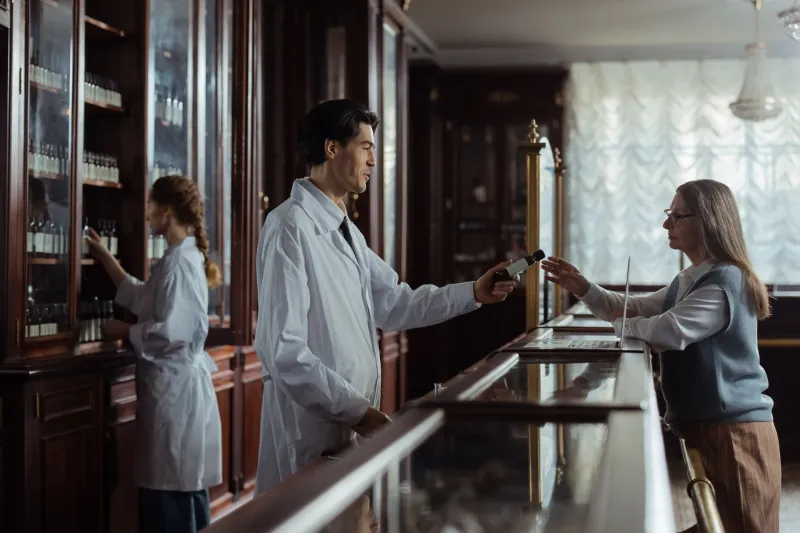
There used to be a person in your town who knew an uncomfortable amount about you. He knew about your bad back, your mother's heart condition, your husband's trouble sleeping. He knew which of your kids got ear infections every winter and which prescription your teenager was too embarrassed to pick up herself. He knew all of this not because he'd hacked your medical records, but because you'd been coming to see him for twenty years.
He was your pharmacist. And in the mid-twentieth century, he was one of the most important people in your healthcare life — often more accessible than your doctor, more knowledgeable than anyone else you could walk in and talk to without an appointment.
That relationship, built on familiarity and genuine expertise, has largely disappeared. In its place: a 90-second transaction at a retail counter inside a big-box store, a robotic dispensing system, and a phone app that tells you your prescription is ready.
The Pharmacist as Neighborhood Clinician
For the first half of the twentieth century, the corner drugstore was a genuinely different kind of place. The pharmacist — often the owner — compounded medications from raw ingredients. There were no pre-packaged pills arriving in bulk from a pharmaceutical distribution center. If your doctor prescribed something, the pharmacist made it, measuring and mixing according to the specific formulation your doctor had written out.
This required serious chemical knowledge. Early American pharmacists trained extensively in chemistry, botany, and basic medicine. They understood drug interactions, dosage thresholds, and contraindications in a way that put them firmly in the category of healthcare provider rather than retail worker. And because they were compounding your medicine from scratch, there was genuine clinical judgment involved in every prescription they filled.
But the role extended well beyond the prescription counter. People came in with symptoms. Rashes, fevers, persistent coughs, digestive problems. The pharmacist listened, asked questions, and offered real guidance. Sometimes that meant recommending an over-the-counter remedy. Sometimes it meant telling someone plainly: you need to see a doctor about this. In communities where doctor's visits were expensive or inconvenient, the pharmacist served as a legitimate first line of medical advice — and people trusted that advice because it had been earned over years of knowing their families.
How the Industry Quietly Transformed
The shift began in the postwar era and accelerated through the 1970s and 1980s. Pharmaceutical manufacturing industrialized rapidly, which meant that most medications arrived pre-manufactured in standardized doses. The art of compounding — once the core skill of the profession — became a specialty service rather than everyday practice. The pharmacist's job changed from making medicine to verifying and dispensing it.
At the same time, the independent corner drugstore began losing ground to chains. Rexall, then Walgreens, then CVS and Rite Aid expanded aggressively through the latter decades of the century. By the 1990s, the independent pharmacy was becoming a rarity in most American cities. The economics of retail pharmacy shifted toward volume — filling as many prescriptions as quickly as possible — rather than the slower, relationship-based model of the neighborhood store.
Liability concerns accelerated the retreat from advice-giving. As the legal environment around medical guidance became more complex, pharmacy chains began training staff to refer virtually any substantive health question to a physician rather than engage with it directly. The result was a profession that retained deep pharmacological knowledge but was institutionally discouraged from using much of it in patient-facing conversations.
Automation completed the picture. Modern pharmacy systems can verify prescriptions, flag interactions, and track refill schedules with minimal human involvement. Some locations have moved toward largely automated dispensing models. The efficiency gains are real. The personal relationship is gone.
What Was Actually Lost
It's easy to romanticize the past, and it's worth being honest: the old model had real limitations. Pharmacists of earlier eras sometimes offered advice that was outdated, occasionally wrong, and shaped by the biases of their time. Consolidation and standardization genuinely improved consistency and safety in many respects. The modern pharmacy system, for all its impersonality, catches drug interactions at a rate that would have been impossible in a hand-compounded world.
But something real was lost when the pharmacist stopped knowing your name.
In a country where primary care access remains uneven — where millions of Americans struggle to get timely appointments with a doctor, where urgent care visits cost hundreds of dollars, where the emergency room is still too often the default for problems that shouldn't require one — the erosion of the pharmacist as a genuine healthcare advisor has real consequences. There's a gap where that trusted, accessible, knowledgeable figure used to stand.
Some pharmacies have tried to reclaim pieces of this. Consultation windows. Pharmacist-led medication reviews. Expanded roles in chronic disease management and vaccination. These are genuine efforts, and they matter. But they exist within a corporate retail structure that still fundamentally optimizes for transaction speed rather than patient relationship.
The Counter That Knew You
The corner drugstore is mostly gone now — converted, consolidated, or closed. The soda fountain that often sat alongside the prescription counter is a memory. The pharmacist who watched you grow up, who knew your allergies without looking them up, who told your dad straight that the cough syrup he was taking wasn't going to help and here's what actually would — that person is largely a figure of the past.
What replaced him is faster, cheaper, and more scalable. It is also, in ways that are hard to fully quantify, a little less human. And in healthcare, the human part has always mattered more than the industry likes to admit.