The Doctor Behind the Counter
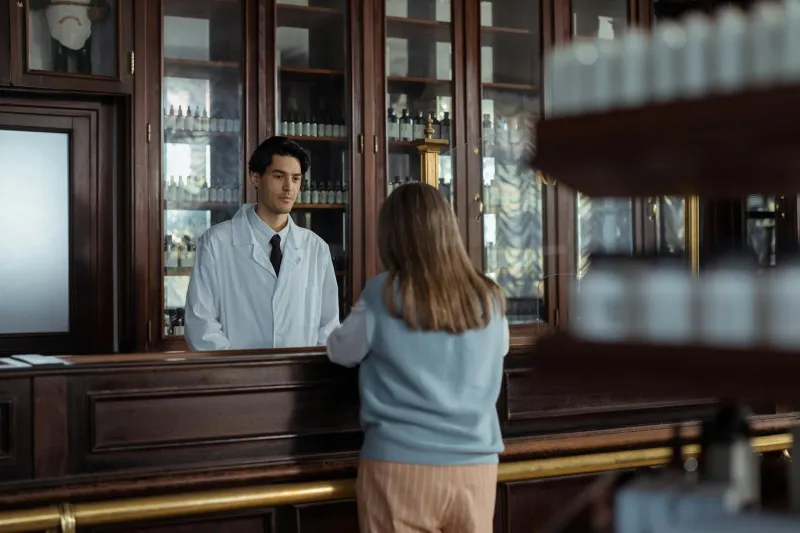
When Eleanor Schmidt walked into Mueller's Pharmacy on Milwaukee's south side in 1967, she didn't need to explain anything. Otto Mueller, who'd been filling prescriptions on the same corner for thirty-two years, took one look at her and reached for the blood pressure cuff he kept behind the register.
 Photo: Otto Mueller, via swall.teahub.io
 Photo: Eleanor Schmidt, via static.wikia.nocookie.net
"Looks like the arthritis is acting up again," he said, noting how she favored her left knee. "And I'll bet Dr. Kowalski wants to check those numbers before he adjusts your heart medication."
He was right on both counts. Otto knew Eleanor's complete medical history not because he had access to electronic health records — those didn't exist — but because he'd been her pharmacist since she was thirty-five. He knew her husband's diabetes medications, her daughter's asthma inhaler schedule, and which over-the-counter remedies worked best for her grandson's frequent colds.
This wasn't exceptional service. It was just pharmacy.
When Drugstores Had Souls
For most of the 20th century, the American pharmacy was fundamentally different from today's corporate chains. The typical drugstore was owned by the pharmacist who worked there, often for decades. These weren't just places to pick up prescriptions — they were community health centers, informal medical clinics, and social hubs rolled into one.
The pharmacist knew not just your medications but your medical story. They'd flag dangerous drug interactions not because a computer algorithm caught them, but because they remembered that you'd had problems with similar medications before. They'd counsel patients on side effects, recommend timing adjustments, and often serve as the bridge between patients and their doctors.
Many drugstores doubled as soda fountains, where the pharmacist might recommend a cherry Coke for an upset stomach or suggest that someone looked like they needed to sit down and rest. The prescription counter was just one part of a broader relationship with community health.
The Numbers Tell the Story
In 1960, there were about 58,000 pharmacies in America, and roughly 70% were independently owned. Today, there are about 67,000 pharmacies, but only 22% are independent. The rest belong to chains like CVS, Walgreens, and Walmart, where pharmacists are often employees rather than owners, and turnover rates make long-term relationships nearly impossible.
The average independent pharmacist in 1970 filled about 150 prescriptions per day and knew most of their customers by name. Today's chain pharmacy pharmacist might fill 300-400 prescriptions per shift while also managing insurance claims, vaccination schedules, and corporate compliance requirements. The time available for patient counseling has shrunk from an average of 5 minutes per prescription to less than 90 seconds.
This shift shows up in patient satisfaction surveys. Despite having access to more medications, better insurance coverage, and more convenient hours, Americans consistently rate their pharmacy experience lower than their grandparents did.
The Lost Art of Pharmaceutical Care
The old-school pharmacist was part chemist, part counselor, part detective. They'd notice when someone looked unwell, ask about side effects without being prompted, and catch medication errors before they became dangerous. They knew which patients were likely to skip doses, which ones needed extra encouragement to follow their treatment plans, and which families were struggling financially with prescription costs.
Take drug interactions — one of the most serious risks in modern medicine. Today's computer systems are excellent at flagging potential problems, but they generate so many alerts that pharmacists often suffer from "alert fatigue." The human pharmacist of 1970, working with a smaller number of patients they knew well, was often better at catching the subtle interactions that computers miss.
They also provided services that have largely disappeared: compounding medications for specific patient needs, making house calls for elderly customers, and serving as informal medical advisors for people who couldn't afford frequent doctor visits. Many pharmacists kept detailed records of what worked for specific patients, creating personalized medicine decades before the term became fashionable.
When Health Care Was Personal
The relationship between pharmacist and patient was built on continuity and trust. Pharmacists often worked in the same location for their entire careers. Customers would drive past closer pharmacies to maintain their relationship with a pharmacist who knew their family's medical history.
This personal connection had real medical benefits. Studies from the era show that patients were more likely to take medications as prescribed when they had a relationship with their pharmacist. They were more likely to ask questions about side effects, more likely to report problems early, and more likely to maintain long-term treatment plans for chronic conditions.
The pharmacist also served as a crucial safety net. In an era when many Americans had limited access to regular medical care, the neighborhood pharmacist was often the most accessible health professional. They'd recommend when someone needed to see a doctor, provide basic health screenings, and offer advice on managing chronic conditions.
The Efficiency Revolution
Today's pharmacy system is undeniably more efficient in many ways. Prescription processing that once took 30 minutes now takes 15. Insurance verification that once required phone calls now happens automatically. Drug safety checks that once relied on human memory now use sophisticated computer algorithms.
Drive-through windows, automated dispensing systems, and electronic prescribing have eliminated many of the inconveniences of old-school pharmacy. You can pick up prescriptions at any location in a chain, transfer prescriptions instantly, and get medications delivered to your door.
But efficiency and effectiveness aren't the same thing. While prescriptions are filled faster, medication adherence rates have actually declined over the past thirty years. Despite having more safety technology, medication errors remain a significant problem. And while pharmacies are more convenient, patient satisfaction with pharmaceutical care has steadily decreased.
What Modern Medicine Forgot
The transformation of American pharmacy reflects broader changes in healthcare: the shift from relationship-based care to transaction-based service, from small-scale personal attention to large-scale efficiency, from knowing patients as people to managing them as data points.
Modern pharmacists are often just as knowledgeable and caring as their predecessors, but the system they work within makes it nearly impossible to develop the kind of relationships that once defined pharmaceutical care. Corporate metrics focus on speed and volume rather than patient outcomes. Insurance requirements prioritize cost containment over personalized service.
The irony is that as medications have become more complex and numerous, the need for personalized pharmaceutical guidance has actually increased. The average American over 65 takes five prescription medications daily — far more than previous generations. Yet the system designed to manage these medications has become increasingly impersonal.
The Cost of Progress
We've gained a lot in the evolution of American pharmacy: better drug safety monitoring, more convenient access, lower costs through insurance coverage, and more sophisticated medications. But we've also lost something valuable: the human element that once made pharmacy a form of healthcare rather than just retail.
Some modern pharmacies are trying to recapture elements of the old model through specialized services like medication therapy management and chronic care programs. But these efforts swim against the current of a system that prioritizes efficiency over relationships.
The neighborhood pharmacist who knew your blood pressure by heart represented more than just personalized service — they embodied a different philosophy of healthcare, one that saw health as a community responsibility rather than an individual transaction. Whether that model can be recreated in our current system remains an open question, but its absence is felt by anyone who's ever stood in line at a busy chain pharmacy, prescription in hand, feeling like just another number in the system.