The Handwritten Ledger That Fed a Town: How the Corner Store Tab Ran on Trust Before Credit Scores Existed
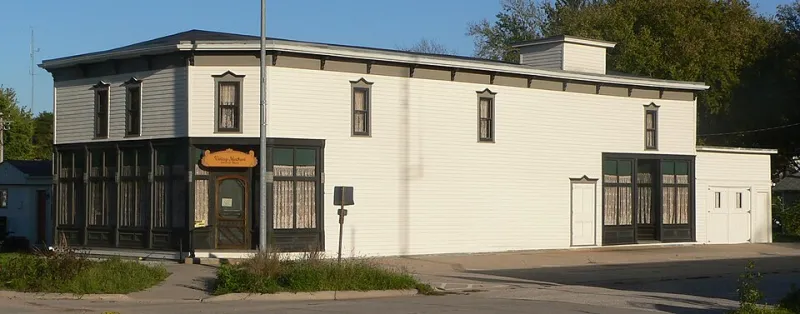
Photo: Ammodramus, CC0, via Wikimedia Commons
The ledger sat behind the counter. It wasn't fancy — a composition notebook, maybe, or a ruled accounting book with a cracked spine. The storekeeper knew every name in it. He knew which families always paid on Friday, which ones needed until the end of the month, which ones were going through something hard and might need a little extra grace. He wrote it all down in pencil, and the whole system ran on something no algorithm has ever successfully replicated: knowing your customer as a person.
The store tab is one of those institutions so embedded in American life for so long that its absence is hard to fully register. For generations — stretching back well before the Civil War and persisting in some communities into the 1970s — the informal running tab was how ordinary Americans managed the gap between what they needed and when they got paid. It wasn't a credit product. It wasn't a financial instrument. It was a relationship.
How the Tab Actually Worked
The mechanics were simple enough. A family — usually one the storekeeper knew well, often from the same church or the same neighborhood — would come in for flour, salt pork, kerosene, whatever the week required. If cash was short, the owner would note the purchase in his ledger under the family's name. The amount accumulated until payday, harvest time, or whenever money came in. Then the customer settled up, and the cycle started over.
No application. No interest rate, in most cases. No credit check, because the check was the relationship itself. The storekeeper's assessment of your creditworthiness was based on whether he'd watched you keep your word for the past five years, whether your family had roots in the community, whether he trusted that you'd come back.
In agricultural communities, this calendar was literal. Farmers ran tabs through the planting and growing season, when cash was essentially nonexistent, and settled when the harvest came in. The country store was an economic anchor that made farming viable in years when the timing of income and the timing of expenses simply didn't match — which was most years.
In urban neighborhoods, the same system operated on a weekly rhythm. The corner grocery, the butcher, the coal merchant — many ran informal accounts for regular customers who lived paycheck to paycheck. You charged what you needed Monday through Thursday. You paid on Friday. The storekeeper floated you the difference, interest-free, because you were a known quantity and because his business depended on your loyalty as much as your cash.
The Social Architecture of Credit
What made the tab system work wasn't generosity, exactly. It was accountability — the specific, inescapable accountability of people who live in the same community and have to look each other in the eye.
If you ran a tab at Johnson's Grocery and skipped out on it, you didn't just lose access to Johnson's. You lost standing in the neighborhood. Word traveled. The butcher two blocks over heard about it. Your children's friends' parents heard about it. The social cost of default was severe in a way that a ding on a credit report simply isn't, because it was immediate, local, and personal.
That accountability ran both directions. A storekeeper who refused to extend credit to a family going through a genuine hardship — a death, an illness, a bad season — risked his own reputation. The community expected a certain generosity from its merchants. The tab was a social contract, not just a financial one.
There were failures in the system, of course. Storekeepers sometimes exploited the tab to keep poor families — particularly Black families in the rural South — in a cycle of debt that functioned more like bondage than credit. The same trust that made the system work for some could be weaponized against others. The tab was only as ethical as the person holding the ledger.
The Supermarket Killed the Tab
The informal store tab didn't disappear because it stopped working. It disappeared because the stores that ran it disappeared. The postwar supermarket boom transformed American retail in the 1950s and 60s, replacing hundreds of small neighborhood grocers with large-format, cash-and-carry stores that competed on price and volume rather than relationship.
A supermarket chain can't run a ledger for every customer. The math doesn't work, and the intimacy required doesn't scale. When the corner store closed and the family started driving to the Safeway, the tab relationship became impossible — not because anyone decided it was a bad idea, but because the institutional structure that supported it ceased to exist.
Formal consumer credit filled the gap. Bank credit cards became widely available through the late 1960s and 70s, and by the 1980s, the credit score had become the universal proxy for the judgment the storekeeper once made by instinct and observation. Your FICO score is, in a sense, the algorithmic version of your reputation in the neighborhood — an attempt to answer the same question the ledger answered, just without any of the human context.
What the Algorithm Can't Know
The credit score is a remarkable tool. It has extended access to borrowing to millions of people who would never have had a relationship with a neighborhood merchant, and it has done so with a consistency and scale that no handwritten ledger could approach. In that sense, it represents genuine progress.
But it knows nothing about why your payment was late. It doesn't know that you were caring for a dying parent, or that your employer missed payroll, or that you've been a reliable presence in your community for twenty years. It doesn't know that you always came back and always paid when you could. It processes data, not character.
The buy-now-pay-later apps that have exploded in popularity over the past decade are sometimes described as a modern reinvention of the tab. And there's a surface resemblance — deferred payment, no immediate cash required. But the BNPL model is built on fees, interest, and behavioral data harvesting. It's not a relationship. It's a product.
The corner store tab was a product too, in its way. But it was also evidence that the people in your community were willing to bet on you. That's a different thing entirely. And it's been a long time since most Americans had access to it.