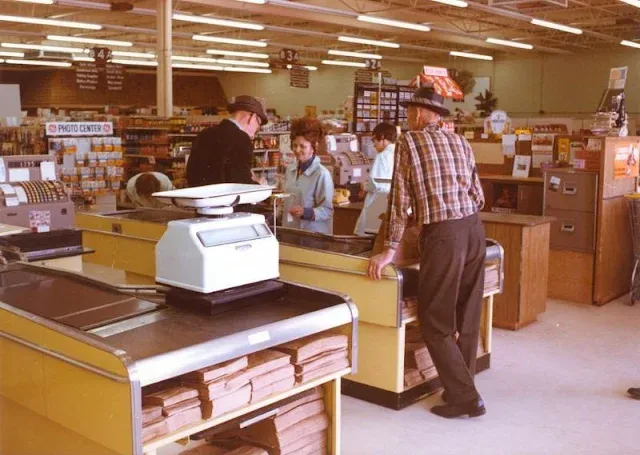
Photo: vintage american grocery store price tags 1970s checkout, via blogger.googleusercontent.com
Ask your grandmother what a gallon of milk cost in 1975, and she'll tell you without pausing. Ask a typical 30-year-old today what milk costs, and you'll get a squint, a shrug, and a guess that's off by a dollar either way.
That's not a personal failing. It's a quiet economic shift that happened to all of us, and almost nobody noticed it happening.
The Era of the Mental Ledger
For most of American history, keeping prices in your head wasn't a hobby — it was a survival skill. Prices were stable enough to memorize and salient enough to matter. A household budget lived and died on the cost of staples: bread, coffee, eggs, gasoline, a first-class stamp.
People talked about these numbers the way we now talk about mortgage rates. When the price of a stamp went up a penny, it was news. Gas stations famously fought price wars down to the fraction of a cent, and drivers knew which corner had the cheap pump because the difference was worth knowing.
Wages, meanwhile, moved slowly and rarely. If your paycheck was steady and the price of the grocery cart jumped, you felt it immediately — because you knew what the cart was supposed to cost.
Why the Ledger Erased Itself
Several forces conspired to wipe that mental database clean.
Inflation became permanent. After the 1970s, prices never truly settled. When everything drifts upward year after year, no single number stays memorizable. A price you learned in 2010 is simply wrong in 2020, so the brain stops bothering to store it.
Wages absorbed the shock. As incomes grew over decades, a 30-cent increase in the cost of bread stopped feeling like a crisis. The stakes of knowing shrank.
Payments went invisible. This one might matter most. When you handed over cash, every transaction had a physical moment — you counted the bills, you got change, you felt the wallet get lighter. A card tap or a saved checkout profile removes that moment entirely. Research on payment psychology has consistently shown that people spend more, and recall less, when paying without cash. The receipt goes in the bag. The number never lands.
Subscriptions and dynamic pricing finished the job. When the price of your flight, your hotel room, or even your ride across town changes hourly, there is no "correct" price to know. The mental reference point dissolves entirely.
What We Lost When We Stopped Counting
Here's the opinion part: this shift quietly transferred power from shoppers to sellers.
Price awareness is a negotiating position. When you know what a pound of coffee should cost, a markup offends you, and you walk. When you don't, every price is plausible, every fee is ignorable, and "shrinkflation" can eat your grocery bag one ounce at a time without triggering alarm.
It also changed how we save. A generation that tracked prices naturally noticed when something was genuinely on sale versus marked up to be marked down. Today, studies of consumer behavior suggest most shoppers can't distinguish a real discount from a manufactured one — because they have no baseline to compare it against.
And there's a subtler loss. That mental ledger was a form of economic citizenship. Knowing what things cost meant understanding your own life in numbers: what a week of work bought, what a year of diapers ran, what a gallon of gas did to a road trip budget. It made inflation personal rather than abstract.
Getting the Ledger Back
The good news is that the skill is recoverable, and it doesn't require a spreadsheet. It requires roughly a month of attention: look at the receipt before you crumple it. Check the unit price, not the sticker. Pick five staples you buy weekly and learn their numbers cold.
Your grandmother didn't memorize prices because she loved arithmetic. She did it because knowing was power — the power to spot a bad deal, question a price hike, and know, at any given moment, exactly where the household stood.
We traded that power for convenience. It might be time to take a little of it back.