The Forty-Five Minutes That Used to Belong to Nobody: How the Commute Became Another Shift
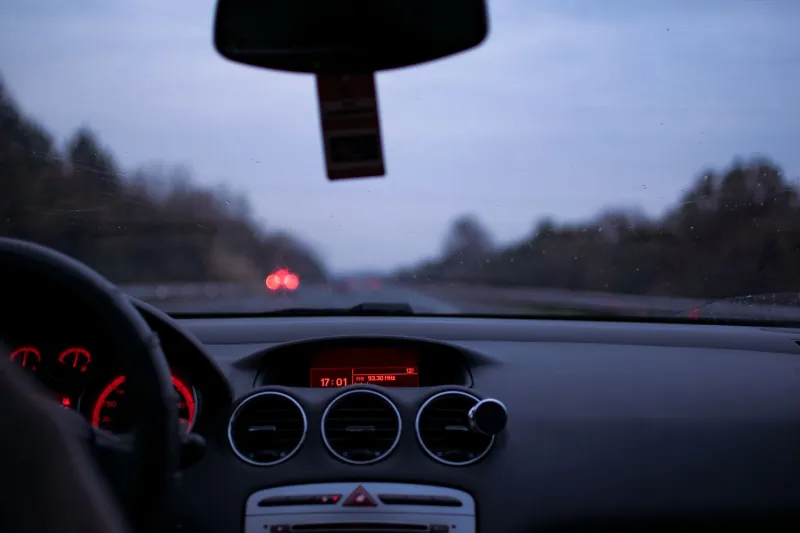
At some point in the not-so-distant past, the drive home from work was useless time. Nobody expected anything from you during it. Your boss couldn't reach you. Your inbox couldn't follow you. The radio played whatever it played, traffic moved at whatever pace it moved, and for thirty or forty-five minutes, the workday was genuinely over.
That stretch of time — structureless, low-stakes, impossible to optimize — turns out to have been quietly essential. And most American workers have now traded it away without fully realizing what they gave up.
What the Analog Commute Actually Was
Before smartphones became standard equipment, the commute home operated as an involuntary buffer zone. You left the office, got in the car, and entered a space that was neither work nor home. The AM radio played Top 40 or talk or classic rock. Maybe you had a cassette in the deck. The drive required just enough attention to keep you from thinking too hard about anything else.
Psychologists now have a name for this kind of low-demand mental activity: it's sometimes called "attentional restoration." When the brain is occupied by something that doesn't require full cognitive engagement — driving a familiar route, listening to music, watching scenery pass — it has an opportunity to quietly process and release the accumulated stress of the day. The prefrontal cortex, which has been working hard all day making decisions and managing social dynamics, gets to idle.
The analog commuter wasn't wasting time. They were, without knowing it, doing something genuinely restorative. By the time they pulled into the driveway, the transition was largely complete. They were home — mentally, not just physically.
The Smartphone Changed the Geometry of the Day
The iPhone launched in 2007. By 2012, smartphone adoption in the United States had crossed fifty percent. By 2016, it was nearly universal among working-age adults. And with it came a fundamental restructuring of when and where work could reach people.
The commute was one of the first casualties.
It started small — a quick check of email at a red light, a voicemail returned on the highway, a Slack notification glanced at while waiting to merge. But the cumulative effect was significant: the boundary between work time and not-work time, which the commute had once enforced by simple geography and technological limitation, dissolved.
Today, the average American worker checks their phone within minutes of leaving the office. Many handle actual work tasks during the commute — responding to messages, joining calls, reviewing documents. The commute hasn't gotten shorter. It's just been reclassified as an extension of the workday, without the pay or the acknowledgment.
What Mental Health Research Says About Decompression
The consequences aren't trivial. A growing body of research on work-life boundary management suggests that the ability to psychologically detach from work during non-work hours is one of the strongest predictors of employee well-being, long-term job satisfaction, and resistance to burnout.
Detachment doesn't mean forgetting about work or being disengaged. It means being able to mentally step away from work demands during recovery time. And the research is consistent: workers who can detach sleep better, report lower anxiety, maintain warmer relationships at home, and perform better at work over the long run.
The commute, when it was technologically enforced rather than a matter of personal discipline, provided exactly this kind of automatic detachment. You didn't have to choose to stop checking your email. You physically couldn't. The limitation was built into the infrastructure of the day.
Now that the limitation is gone, detachment requires active, sustained effort — and most workers don't have the bandwidth to maintain it. The phone is always there. The notifications are always arriving. The path of least resistance is to engage, and so most people do.
The Particular Loneliness of the Connected Commute
There's something else worth naming here, beyond the stress metrics and the burnout statistics. The old commute had a particular quality of solitude that has become genuinely rare in modern American life.
You were alone with your thoughts in a way that didn't require effort or intention. Nobody was watching. Nobody was messaging. The radio was company without being a demand. You could think about whatever drifted through — replay a conversation, notice the sky, let your mind wander through something that had nothing to do with quarterly targets or performance reviews.
That kind of unstructured mental wandering is where a lot of creative thinking happens. Where problems quietly solve themselves. Where the emotional residue of a hard day gets processed without anyone having to do anything in particular. Neuroscientists studying the brain's default mode network have found that this kind of mind-wandering isn't idle — it's doing real cognitive work, the kind that focused attention actually prevents.
The connected commute has filled that space with stimulation. There's always something to respond to, something to listen to, something to scroll through. The silence has been replaced, and with it, the specific kind of thinking that silence made possible.
Getting the Buffer Back
Some workers are starting to deliberately recreate the conditions of the analog commute. Leaving the phone in the back seat. Turning off notifications for the duration of the drive. Listening to music with no screen involvement. A few are even taking longer routes home on purpose — not to add time, but to give themselves more of the unstructured mental space that used to come automatically.
The fact that this now requires intentional effort — that people have to fight to protect what was once just a structural feature of the day — says something about how thoroughly the connected world has colonized ordinary life.
The forty-five minutes that used to belong to nobody turned out to belong to the person driving. It just took losing them to figure that out.