Photo: Steve Shook from Moscow, Idaho, USA, CC BY 2.0, via Wikimedia Commons
It started with a problem. The old vacuum cleaner finally gave out, or the winter coat was beyond saving, or you'd decided it was time to replace the living room sofa. And then came the process — unhurried, methodical, and spread across days or weeks — of figuring out what to buy.
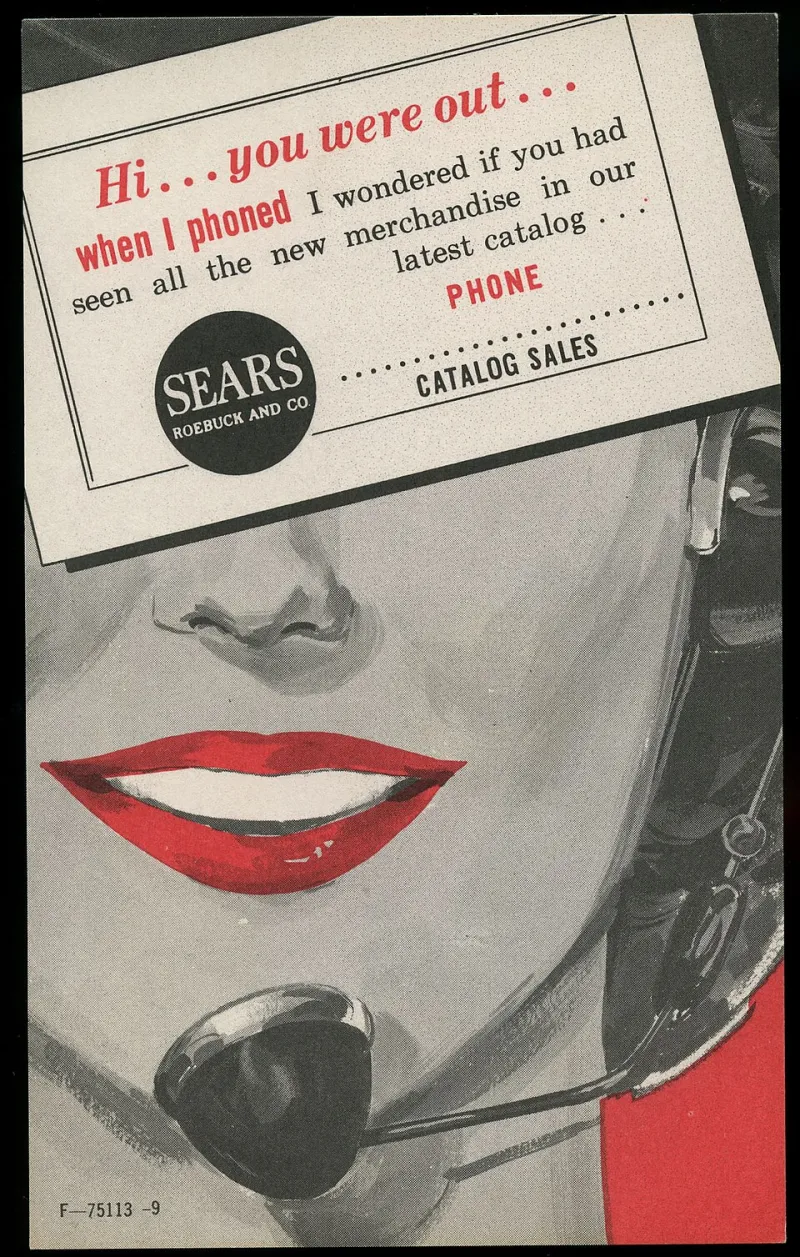
You might have started with a catalog. Sears, JCPenney, or whatever arrived in the mailbox that season. You'd flip through it at the kitchen table, dog-ear a few pages, maybe cut something out. Then came the Saturday trip to the store, where a salesperson who actually knew the product line walked you through the options. You touched things. You sat on the sofa. You asked questions. You went home and thought about it. And eventually, you bought something — and because the whole process had cost you time and attention, you tended to take care of it.
That process is largely extinct. And the thing that replaced it is so fast it barely registers as a decision at all.
The Catalog as a Slow Kind of Desire
Before e-commerce, before even the big-box store era, the catalog was how millions of American households shopped. Sears alone was mailing out catalogs to tens of millions of homes by the mid-20th century — thick, dense books that functioned almost like consumer encyclopedias. People spent real time with them.
The act of browsing a catalog was fundamentally different from scrolling a product page. It was slower, for one thing. You couldn't filter by price in a millisecond or jump between 14 tabs comparing similar items. You read the description. You looked at the illustration. You thought about whether you actually needed it, partly because ordering required filling out a paper form and waiting weeks for delivery.
That friction — the effort between wanting something and getting it — wasn't just inconvenience. It was a natural filter. By the time a purchase arrived, you'd usually thought about it long enough to know whether you actually wanted it. Returns were rare, partly because they were a hassle, and partly because the deliberation period had already done its job.
The Saturday Shopping Trip
For purchases too large or too important to order blind, there was the trip. This was a commitment — a chunk of Saturday, the whole family sometimes, a real errand with a destination. You went to the appliance store, or the furniture showroom, or the hardware store that smelled like sawdust and machine oil, and you engaged with the thing you were considering buying.
Salespeople in this era occupied a genuinely useful role. The guy at the appliance store had often been there for a decade. He knew which washing machine held up and which one the repair guys kept coming back to fix. He had opinions, and they were based on experience rather than an algorithm designed to surface sponsored listings. You might not have loved the sales pressure, but the information was often real.
The trip also carried social weight. Coming home with a new television or a dining room table was an event. Neighbors might come over to see it. The object arrived with a story — where you went, who helped you, what you almost bought instead. The purchase was embedded in a small narrative that made it feel like it belonged to your life.
What One-Click Did to the Psychology of Ownership
Amazon's "1-Click" ordering patent, granted in 1999, was a turning point that didn't get nearly enough cultural attention at the time. The explicit goal was to remove every possible barrier between the impulse to buy and the act of buying. No cart review. No checkout process. No moment of pause where you might reconsider.
It worked, commercially, beyond almost anything the retail industry had seen. And it fundamentally changed the psychological relationship between consumers and their stuff.
When a purchase costs you nothing but a tap, it's hard for that object to feel particularly significant. The $60 kitchen gadget you ordered at midnight because you saw it in a video arrives two days later and sits on the counter for three weeks before you use it once. The return process is easy enough that you might send it back, or might not — either way, the energy investment is low, and so is the attachment.
Research on what psychologists call the "endowment effect" — the tendency to value things more once you own them — suggests that effort and deliberation prior to purchase actually increase how much we value what we buy. When the effort disappears, some of that value disappears with it.
The Return as a Cultural Norm
One of the clearest signals of how purchasing psychology has shifted is the normalization of returns. In 2023, Americans returned an estimated $743 billion worth of merchandise — nearly 15 percent of total retail sales. Some of that is legitimate: wrong size, defective product, misrepresentation. But a significant portion is the downstream consequence of low-friction buying.
When you can order three versions of the same jacket and send back the two you don't want, you're essentially using the retailer's warehouse as a fitting room. This is convenient. It's also a sign that the decision has been offloaded from before the purchase to after it — a reversal of how the process used to work.
The environmental cost alone is significant: returned goods often can't be resold, and a substantial percentage end up in landfills. The convenience that made buying easier created a waste stream that nobody fully planned for.
Faster Isn't Always More Satisfying
The strange thing about all of this is that despite the unprecedented ease of buying things, consumer satisfaction with purchases hasn't obviously improved. The hedonic treadmill — the psychological tendency to quickly adapt to new acquisitions and return to a baseline level of happiness — runs faster now, because the next purchase is always just seconds away.
The old system, slow and effortful as it was, had a built-in mechanism for managing desire. The wait between wanting something and having it gave you time to find out whether you actually wanted it. The trip gave you context. The deliberation gave the object meaning before it even arrived at your door.
None of that made shopping more fun, exactly. But it may have made the things people bought feel more genuinely theirs.