America's Lost Hour: When Lunch Meant Leaving Your Desk Behind
America's Lost Hour: When Lunch Meant Leaving Your Desk Behind
At precisely 12:00 PM in offices across 1960s America, something remarkable happened: work stopped. Completely. Typewriters fell silent, phones went unanswered, and employees walked out the door for what was understood to be their time—a full hour when productivity was irrelevant and the outside world beckoned.
Today, that same hour has become a 20-minute scramble to wolf down a sandwich while checking emails, answering calls, and pretending to be productive. The lunch break didn't just shrink—it disappeared entirely, taking with it a piece of American culture most of us never realized we'd lost.
The Sacred Hour
The mid-century lunch break operated on a simple principle: humans needed genuine breaks from work to function properly. This wasn't revolutionary thinking—it was common sense backed by decades of industrial psychology research showing that well-rested workers were more productive workers.
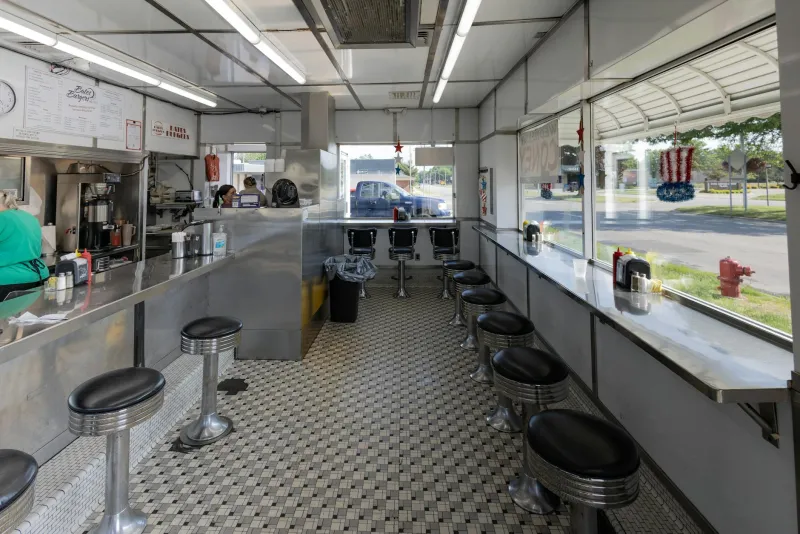
In cities across America, the lunch hour created its own ecosystem. Diners filled with office workers who had exactly 60 minutes to order, eat, chat with colleagues, and return refreshed. Department store restaurants catered to shoppers and workers alike, offering full meals served by waitresses who knew your usual order. Corner delis prepared sandwiches for the grab-and-go crowd, but even "fast" lunch meant sitting down somewhere other than your desk.
Suburban workers often drove home for lunch, a practice so common that many neighborhoods designed themselves around it. Houses built in the 1950s and 1960s often featured eat-in kitchens specifically planned for the working parent who'd return midday for a proper meal and a brief reunion with family.
The Diner as Democracy
Nothing embodied the democratic spirit of the American lunch break like the neighborhood diner. At 12:15 PM, the construction worker, bank teller, and insurance salesman sat side by side at the counter, united by the shared understanding that lunch was time away from whoever was paying their wages.
Diners designed their entire business model around the lunch rush. Menus featured hearty, quickly prepared meals that could be served, eaten, and paid for within 45 minutes, leaving time for actual conversation. The "blue plate special" became an institution—a complete meal at a fair price, served efficiently but without the frantic pace that characterizes today's fast-casual dining.
These weren't just feeding stations; they were social spaces where Americans from different walks of life intersected daily. The lunch counter conversation was where office gossip mixed with neighborhood news, where political opinions were tested against real-world perspectives, and where the social fabric of American communities was woven one meal at a time.
When Home Was Close Enough
For millions of Americans, the lunch break meant going home. This wasn't a luxury—it was standard practice in an era when most jobs were within a reasonable distance of residential neighborhoods. The 30-minute commute that would make lunch at home impossible was far less common when American cities were more compact and suburban sprawl was still developing.
Mothers planned their days around the lunch return, preparing meals that could be ready when the breadwinner walked through the door. Children came home from school for lunch well into the 1970s in many districts, creating a midday family gathering that reinforced home as the center of daily life.
This practice created a natural rhythm to the workday that modern Americans have largely lost. The midday break provided a genuine transition, a chance to shift mental gears and return to work with renewed focus. It also maintained the boundary between work life and home life in a way that seems almost quaint today.
The Efficiency Revolution
The transformation began subtly in the 1980s with the rise of corporate efficiency culture. Lunch breaks started to be seen not as necessary rest periods but as lost productivity. The hour away from the desk became an hour that could be better utilized.
Open office plans accelerated the change. When your workspace was visible to everyone, leaving for a full hour felt like making a statement about your dedication. The pressure to appear busy and available gradually eroded the social acceptance of the genuine lunch break.
Technology delivered the final blow. Email, mobile phones, and later smartphones made it possible to stay connected to work even during breaks. The lunch that once provided complete mental separation became another opportunity to catch up, respond to messages, and demonstrate commitment.
The Sad Desk Lunch Era
Today's typical American lunch happens at the desk, consumed while working, lasting about 20 minutes, and consisting of food that can be eaten with one hand while the other operates a computer mouse. The "working lunch" has become so normalized that taking a full hour away from work can feel rebellious.
The statistics are sobering: surveys consistently show that more than 60% of American workers eat lunch at their desks most days. The average lunch break lasts just 30 minutes, and many workers report feeling guilty about taking even that time away from their responsibilities.
This shift has created a generation of workers who have never experienced what their grandparents took for granted: a genuine daily break from the demands of employment. The idea of walking away from work for an hour, sitting down for a proper meal, and engaging in non-work conversation has become so foreign that many young professionals view it as an impossible luxury.
What We Lost Beyond the Hour
The disappearance of the lunch break represents more than just a scheduling change—it reflects a fundamental shift in the relationship between work and life in America. The lunch hour once served as a daily reminder that humans had needs and interests beyond their employment. It created space for community, family, and personal reflection.
The health implications are well-documented: Americans who eat at their desks consume more calories, make poorer food choices, and report higher stress levels than those who take genuine breaks. But the social costs may be even greater. The lunch break was often the primary way Americans connected with colleagues as humans rather than just coworkers.
The economic impact extends beyond individual workers. The disappearance of the lunch break contributed to the decline of neighborhood restaurants, diners, and local businesses that once thrived on midday customers. Entire commercial districts that were designed around the lunch rush have struggled to adapt to a world where workers rarely leave their buildings.
The Impossible Return
Could America ever return to the era of the genuine lunch break? The obstacles are significant: longer commutes, dual-career families, global business hours, and corporate cultures that equate presence with productivity. The infrastructure that once supported the lunch break—neighborhood diners, walkable business districts, jobs close to home—has largely disappeared.
Yet some companies are experimenting with mandated lunch breaks, recognizing that well-rested employees are more creative and productive. The pandemic's work-from-home experiment gave many Americans their first taste in years of eating lunch away from their workspace, and some discovered they'd been missing something important.
The lunch break may never return to its mid-century prominence, but its disappearance serves as a reminder of how quietly work can expand to fill every available moment. In losing the lunch hour, Americans didn't just give up a meal—they surrendered a daily practice that insisted their humanity mattered more than their productivity.
Sometimes the most profound changes happen not through dramatic events but through the gradual erosion of small, daily practices that once made life more humane. The lunch break was one of those practices, and its absence has left American workers hungrier than they realize.